| | | | | |
So kann man
z.B. T[he|ei]le des Nachbildes mit
Teilen des mit offenen Augen gesehenen vergleichen.
• | | |
| | | | | |
It would be a genuine mathematical problem:
‘construct the 2-gon’.
And a [M|m]athematician might solve the problem
i.e. devise a construction which on such
& such grounds we should could hardly
help calling “construction of the
2-gon”. •
| | |
| | | | | |
We1 may, or we may not, feel a discomfort about
it.
| | |
| | | | | | Suppose
[s|I] said “there is something there”;
& on being asked,
“[w|W]hat do you mean?”, I painted a
picture of what I see. Would this justify
saying saying that statement? –
Wouldn't this picture have to be understood as
‘in a system’? And
mustn't I understand 2. it as an
expression within a system?
| | |
| | | | | |
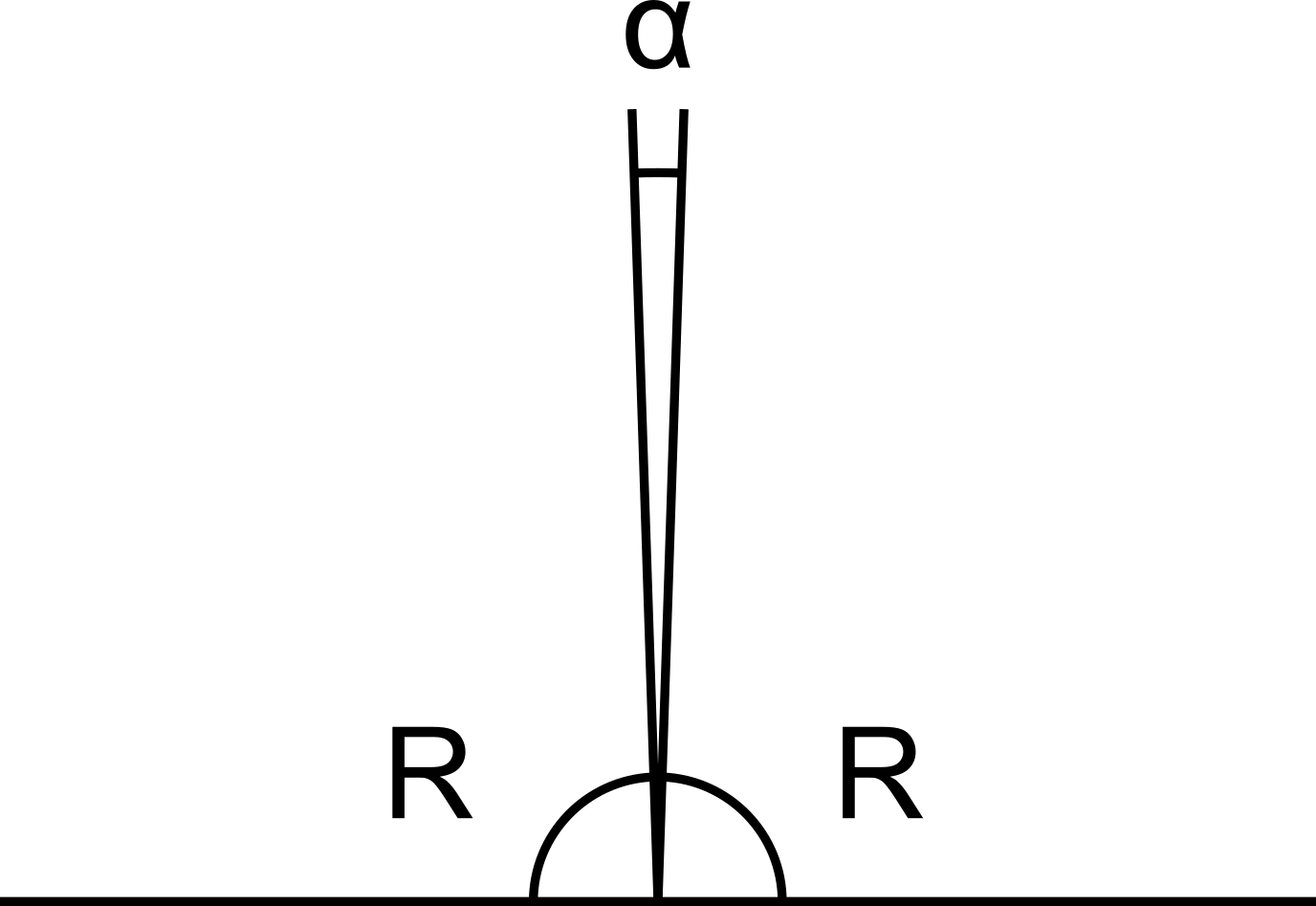 “But
then, how are we to account for the angle
α? Are we to say that R+α =
R?”
| | |
| | | | | |
‘Look at the ˇgeometrical proposition as
a member of the whole system of geometrical
props, then you shall see whether you
really want to this
prop.!’
| | |
| | | | | |
⌊⌊sehr wichtig wenn auch schlecht
gesagt⌋⌋ “It's no use saying that
the other person knows what he sees & not
what I see & that therefore all is symmetrical,
because there is just nothing else corresponding to my visual image;
my visual image is unique!”
| | |
| | | | | | Geometrie in welcher
zwei Gerade die einen Winkel bilden erst ein
Stück mit einander laufen; zu vergleichen einer Mechanik in der
ein Körper auf den keine Kräfte wirken sich mit langsam
abnehmender Geschwindigkeit bewege.
3.
| | |
| | | | | |
“Obviously this↗) is what's
seen!”
| | |
| | | | | | If
one sais to the solipsist
John Smith
“so you say that of all people only John
[s|S]mith really sees”, he
doesnt really recognize
this to be his view. He didn't really mean
that if you regard him as one man amongst other men person out
of many people he had any special privilege. –
He would be inclined to say: “Not John
Smith has any particular privilege (it would be
ridiculous to say this), but I have, as seen
by myself.
| | |
| | | | | |
Couldn't one assume that all those persons had a right to
talk about what's seen who were being seen.
I.e. all those who were one a picture
could talk about the picture.
| | |
| | | | | |
“But I can persuade myself that nobody else has pains even
if they say they have, but not that I
haven't.”
It makes no
sense to say, that “I persuade myself that I have
no pain” whoever says this.
I don't say anything about myself
when I say 4 that I can't persuade myself
that I haven't pain etc..
| | |
| | | | | | Can't I use the word
“to see” in such a way that I call only this→
‘seen’?”
But how do I
act according to this decision? Do I,
e.g. admit that someone else besides me can see
it, or do I say that only I can see it?
Suppose
everybody talked only about what we should now describe as
‘What's seen by me
L.W.’. But they all know what
I see; they don't ask me. And if anybody
describes it wrongly we say that he
speak properly,
expresses himself wrongly. There is no such thing as
deceiving somone about what I see. –
Can't I even then imagine a
temptation
Isn't there even then a temptation |
to say, “I can only know
what I see not what the others
see?”?
| | |
| | | | | | Su If I say
“I see this→” I am liable to
tap my chest to show which person I am. Now suppose I had
no head & pointing to my geometrical eye I would point to
a⌊n⌋ ˇempty place above my neck, wouldn't I still
5 feel that I pointed to the
person who sees ta⌊p⌋ping my chest? Now I might ask
d “how do I know in this case who sees
this?” But what is
this. It's no use ˇjust pointing
ahead of me, & if, instead, I point to a description &
tap both my chest & the description & say
‘I see this’ – it
no sense to ask “how do you know
that it's you who sees it” for I
don't know that it's this person
& not another one which has sees before I point;
but one could in certain cases say I know because I
point. – This is what I meant by saying that I
dont chose the mouth which says
“I have toothache”.
| | |
| | | | | |
Der, wenn ich so sagen darf, krankhafte Charakter des Solipsismus
zeigt sich wird offenbarzeigt sich,
wenn wir die Consequenz zu ziehen versuchen
daß nur ich N.N. wirklich sehe, da
wir vor dieser Consequenz sofort
zurückschrecken. Wir sehen 6. sofort, daß wir das gar
nicht sagen wollten.
| | |
| | | / | | | Isn't it queer that if I
look & point in front of me & point in
front of me & say “this!”, I should
know what ˇit is I mean. “I mean just
these shades of colour and shapes, the
appearance.”
| | |
| | | | | | [Ein Wissenschaftler sagt er
betreibe nur empirische Wissenschaft oder ein
Mathematiker nur Mathematik & nicht Philosophie, –
aber er ist auch den Versuchungen der Sprache
unterworfen & muß sich wie
jeder, er ist in der gleichen Gefahr wie jeder
Andre &
muß sich vor ihr in [A|a]cht nehmen.]
| | |
| | | / | | | If I say
“I mean the appearance”, it seems that,
though I had sa[y|i]d ⌊am⌋ tell⌊ing⌋ you what it is I am pointing , or looking at, e.g. the chair
as opposed to the bed, etc.. It is as
though ˇby the word
“appearance” I had actually directed your
attention to something else than
w e.g. the physical
objects you are looking at. And indeed there corresponds a
peculiar stare to this ‘taking in the
appearance’. Remember here what
people Philosophers of a certain
s⌊c⌋hool 7. used to say so often:
“I believe I mean something, if I say
‘ …’”.
| | |
| | | ∕∕ | | | It seems that the visual
which I'm having
is something I can point to; that I can say of it, it is
unique. // … I can point to & talk
about;
// . That I am pointing
the physical objects I am
looking in my field of vision, but not
meaning them but the appearance. This object I am
talking about, if not to others then to myself. (It is
almost like something painted on a screen which surrounds
me)
| | |
| | | ∕∕ | | | This object seems to
be ˇis described as “that which I
see”, “my visual image”, as it has nothing
to do with any particular human being. Rather I should like
to call it “what's seen”. And
so far it's all right now I've got to say what can be
said about this object, in what sort of language game.
“What's seen” is to be
used. For at first sight one should feel inclined to use
th[e|i]⌊s⌋ words
expression as
one uses a word designating a physical object & only on second
thought that I can't do
that. – When I said 8 that here seems to be an object I can
point to & talk about, it was just that I was comparing it
with to a physical object. For
o⌊n⌋ly on second thought it appears that the idea of
“talking about” isn't applicable
here. (I could have compared the
‘object’ to a theater
decoration.)
| | |
| | | / | | | Now under when could I
be said to speak about object?
When would I say I did speak about it? –
Obviously when I describe – as we should say –
my visual image. And perhaps only if I
described
it, & only if I
described
it to myself.
But what is the point in this
case o[t|f]o
say⌊ing⌋ that when I
describe to myself what I see I describe a an
(peculiar) object called
“what is seen”? Why talk of a
particular object here? Isn't this due to a
misunderstanding?
| | |
| | | | | |
Imagine a game played on a kind of
chessboard. You can extend the game to 64, 81,
100, etc. squares & the situation which is
loosing in the 64-game is winning 9 in the 81-game, loosing
in the 100-game, winning in the 121-game
etc..
What di
If you are asked “what did ‘meaning what
he said’ consist in” you will describe
which however
supplemented by ˇcertain other facts would be
characteristic of his not meaning what he said, –
and so on.
| | |
| | | | | | “Can I
imagine 10101010 = μ
[S|s]oldiers in a
row?”
“Can I imagine an endless
row of [S|s]oldiers?”
Why
shouldn't I say, I can imagine an endless row of
soldiers?
the image is something like a row the end of which I
can't see & a gesture & the words
“on & on for ever –” said in a
particular tone of voice. And suppose I said:
μ soldiers would reach from here halfway to the sun if we
placed them a yard apart!?
Isn't this too ‘imagining the
row’?
| | |
| | | ∕∕ | | | It is a very remarkable &
ˇmost important fact that there are numbers which
we all of us should call
“ numbers”.
| | |
| | | | | | There is a particular way of
explaining the sense (meaning) of an expression which we may
call
10
| | |
| | | | | |
In philosophy we often say that people wrongly imagine a
certain state of afairs, e.g.
“they imagine that a law o⌊f⌋ nature in some way
compels things to [p|h]appen”, ort
“they imagine that it's a question of psychology
how a person can know a certain fact whereas it is one of
grammar” etc. etc..
But it is necessary in these cases to explain what it
means “to imagine this so &
so”, what kind of image is it they are using.
It often sounds as though they were able to imagine the logically
impossible & it is not easy to straighten out our
description of the case & to say what ˇin this case
they actually imagine.
E.g.: People treat the question
“how do we know what so & so is the case” as
a question of psychology which has nothing to do with the sense of the
prop which we say is known. But
first: where do they take this idea from, how do they
come by it? Which ˇreally psychological question
are they thinking of?
There
Obviously there is a case in which the question
“how does he find this out” is a personal &,
perhaps, psychological 11 one. “How did he
find out that N was in his room?” –
He saw him through the window or he was hidden under the bed. – “How did he find out that the
glas was cracked?” He saw the
krack with his naked eye or he saw it through the
gl magnifying glass
etc. We say he finds out the same thing in
different ways & therefore not that what he finds
depends upon how he finds it.
When do we say that he
finds out the same thing in two ways? Imagine language
games: somebody is asked a question
“A?” & trained to answer
“yes” if he sees a
in the next room,
“no”, if he doesn't. In
He is trained to answer ˇthe question
“A?” by “yes” also if
he hears A's voice from the next room.
“What right have we to ask the same question in these two
cases?” or “What right has he to use
these two different tests to answer the same
question?” Or, suppose someone asked:
“Now are ⌊is⌋
th[e|i]se
really one ˇ& the same question or do we have two
different questions only expressed in the same
words?”
Now concider
the ostensive definition: “This man is called
‘A’” & ask yourself whether
this definition tells us whether ⌊if⌋ we
are to regard seeing A from a different 12 side or in a different position or
hearing his voice as criteria of him being there? –
Here we are tempted to say: “But surely I just
point to this man, so there can't be any doubt
what object I am meaning!” But that's
wrong though the doubt of course is not whether I mean this
→ or that
↘ thing.
One may say that the ‘object’ I am inclined to
say I am pointing to ˇin the ostensive definition is not
determined by the act of pointing but by the use I make of the word
defined. And here one must beware of thinking that after
all even if the pointing finger pointed to a different
object in the sense in which the arrow
⟶
may be said to point
to A [&| or] B, so that by a different
way of pointing I might have distinguished the cases.
“But we conceive of objects, things, different from our
sensedata, e.g.
the table as opposed to the views we get of it.”
But what does conceiving of this object consist in?
Doesn't it is it a peculiar
‘mental act’ occuring whenever, say, we talk about
the table? Isn't it using the word table in
13 the game we do use
it? using it as we do use it?
| | |
| | | | | |
We are tempted to say that the word
“toothache” is the ‘name of a feeling of
which I don't know whether anybody except me ever
has it’. But even I can be said not to
know whether I always mean the same by this word.
| | |
| | | | | | “I always
thought that holding one's cheek was having toothache; then
he knocked out a tooth of mine, then I knew what
‘toothache’ meant”. Well what
does it mean? – what was it like “to know what
‘toothache’ means”?
| | |
| | | ∕∕/ | | | “Now I know what
‘pain’ means”.
| | |
| | | | | | A
faked moan ˇof pain
isn't something necessarily a moan without
something & a real moan ˇof pain a moan with
something.
| | |
| | | | | |
Aber wir möchten sagen: “die
Begleitumstände sind andere”. Aber daran ist
etwas Unrichtiges.
| | |
| | | | | |
You say in one case the expression 14 corresponds to the
. But how does it
correspond?
Imagine, you were wrong about
the correspondence, then what would remain? That you said
these words & that you did not cheat, but now cheating
& not cheating are not ‘private
experiences’. It's no good saying
“I recognize this experience as …” as
ˇ can say I don't know whether I recognize the
experience of recognizing rightly.
| | |
| | | | | |
We are using the word “to
cheat” in two different ways. In one way whether I
do it can be verified by the other person, in the other sense we say
“only I know whether I cheat”.
| | |
| | | | | | “I knew all the time
that I had cheated.”
| | |
| | | | | |
Quite true, we distinguish simple acting & acting
prompted by feeling, & feeling with . These are distinctions in
our language. “But are you saying that all these
distinctions are distinctions in mere behaviour?”
–
| | |
| | | | | | Can one by
multiplying 2 with itself
12? 15
| | |
| | | | | |
“Mere behaviour”.
“There is only behaviour” would seem to say that
there was no life that we (or I) acted as
automatons, as unconscious
mashines.
I wish to
say: “The difference between me & a
mashine doesn't
consist in the difference of our
actions but in this that I am conscious & the
mashine isn't”.
But oughtn't I say that this only
distinguishes a machine from me not from a human
being? For why shouldn't I say that the
difference between a human being, animal, sewing machine,
etc., lies in their actions, if I except
myself. But then I dont even except
my body.
| | |
| | | | | |
“I know consciousness only from myself, I
don't know whether anybody else is
conscious has consciousness, but it makes sense
to assume it & I do make the assumption in
cases.”
| | |
| | | | | | What
worries us is the idea of ‘behaviour +
[E|e]xperience’. – We might think
that it was possible to talk of behaviour without ˇthere being
experience. ‘Could I talk about moaning if there
was no such thing as hearing the moaning?’
Or: Does Isn't talking of
behaviour
¤ 16 | | |
| | | | | |
“I want someone to explain to me a certain
game & to make it
eas[y|i]⌊er⌋
I put the question to him: “tell me what a man does to
winn the game.” Someone might say
“I don't want to know what a man does to win it,
this is a question about human beings; I want to want to
know what the game is they play.”
The
analogy we might be mislead by is this:
you ask the question “
You ask,
what does it mean that “a rod is 6 inches
long”. Someone answers one finds
[it|ou]t whether it is so by using a measuring
rod divided into equal parts. “What does this
mean?” – One divides it
into equal parts in such & such a way. I have
given a definition in terms of the way of verification.
“But isn't this an indirect
definition?” Sometimes it is, sometimes it
isn't.
Sometimes how we look for something
may determine what we are looking for, sometimes it
doesn't. – We are always liable to think of
the fact that we can find out that there is a chair here in many
different ways & we forget that this is just conditioned by
the particular use we make of the word “chair”,
“table” & in general the generic names of
physical 17. objects. ⌊⌊
[s|S]upposing we said “what does it mean
to have an enla⌊r⌋ged liver & someone answered
“we ver[y|i]fy it by looking at the
persons eye & seeing
…” ⌋⌋
Describe an object by describing
its use.
Describe an object by
saying what hollow it fits into.
More
ore less of it's use is expressed by
different forms of a
prop.
Concider this! The sense of a
prop is what you must know to understand
it.
What does understanding a question consist
in?
What does it mean to understand a
mathematical question?
Would you understand
‘25 × 25 = ?’ if
you didn't know how to calculate it? Would you
say you understood position of a
board game if you had no idea of the way the game was
played? ˇAsk How much must you know to
understand it? Would you not be inclined
to say that you understand it more & more the more you knew
about the game? But we could also imagine a case
whe in which you would say that you understood
the position even though you knew nothing didn't know the exact rules of the
game, even if these rules had not yet been given!
Now
concider such a question
as “are there
an inf. nr. of primes or
not, 18 & if not, how
many?” I show you what we call a prime
nr. & ask you if you
understand this question. Prima
facie you all say yes. Now I want to show you that you
could also look at it from a different & perhaps more
‘exact’ point of view & say
‘no’. We have here a question but we have
not yet got a method of it's solution & I want
you to think of it in terms of 25 × 25 = ? when we
don't know what multiplication is. Now
I'll say (what I've said in a similar case
before): The question for you gets it's
sense by the idea picture of a small finite
nr. of cardinals
etc.. But what does that mean?
In the case of the small nr of
cardinals you have a method, you know what to do, here you
don't know it, so it mean, that “the question gets it's
sense from the case in which you do know
it”?
Our mind works on the line that there is
something which
could but for our weakness be calculated
which hasn't yet been calculated |
it takes ˇno
notice of the fact that we have no method & although this
can't alter the facts it determines the way of
expressing: We say we don't yet know so
& so; & if someone shows 19 us
Euler's proof we say
that now we know the answer to the question we have asked.
But are we bound to express ourselves in this way?
Can't I persuade you to adopt a different way of
expressing ourselves of which too we can't say that it is
inconsistent with the usual use of
words? What if I say: This question
i.e. the form of words was indeed suggested by
the finite case, but the analogy just brakes
down because there is no method of solution.
Eulers
“proof”
needn't be conceived as answering the question
“how many primes are
there”.
This question
might perfectly well be said to be nonsensical.
(As e.g. “what colour has visual
space.”). “But is it in our power
to regard as question as nonsensical or as making
sense? And what about
Eulers
proof?” Need we ask such a question as
“how many cardinal numbers are there”?
This question which seems in some way to get hold of the infinite
i.e. the enormous for this reason might appeal
to some of us & might, on the other hand,
repell some of us, – e.g.
me. Funeral
Concider such a
prop as: “There are
as many squares as there are cardinals”. If we
look at it like this: 1, 2, 3, 4, 5, 6, 7, 8,
9 … we should be 20. inclined to say that there
were less squares than cardinals; if we think
of them as 1²,
2², 3², 4², …, we
shou say, there are as many. ⌊⌊
Thinking in terms of an analogy doesnt mean
that this analogy is constantly before our mind. The
Idea of finding out something about the series of
cardinals. ⌋⌋ Why shouldn't we draw the
conclusion that this whole question doesn't make
sense? But we actually say that it does, &
part of it's charm that the answer is in a
way paradoxical adds ˇfor some to it's
charm. (Some + some = some). It
seems to us that we have discovered a new element with utterly
different properties. I should like to get rid of this analogy. – Can “the heptagon be
constructed?” – A
“Now surely this question makes
sense!” – B “Now
surely this question makes no sense!” –
What argument would A use: “you know what it
means ‘to construct the pentagon,
, so …,
ˇyou know what a heptagon is, what construction
means”. B: “It
makes no more sense to say ‘can the
7 gon be constructed’,
than to say ‘can the 5-gon be
constructed’. I know what we call ‘a
constructed (as opposed to measured) pentagon’, I know
what we call ‘the
pentagon-construction’. We use this
expression because of certain obvious analogies. But
I don't [k|c]all anything heptagon
construction. So don't ask such a question as can
it be …. Compare this with the statement
“on this animal's forhead there
21. was a heptagon
constr.’ –
answer: I don't know what you're talking
about. “But what about the proof that the heptagon
can't be constructed? As there is such a proof,
it is the answer to that question of which you say it makes no
sense. “Must I conceive of this proof as the
answer to that question?” When the
proof is given I can say: you have now given the
expression 13 gon sense
& you have decided that the expression construction of the
7 gon is
to be used at
all’. Further you have now given the
question: “can the
7 gon be constructed”
sense, analogous to that can 735912 be
devided by 19.
| | |
| | | | | | Now back to the question
“how many 777 are there in
π.” When I say
that the case of the small first
nr. gives this question its first meaning
this is to say that our attitude towards this expression is due to it
sounding like that other kind of question. Our attitude can
however change if I now remind you of the cases
I've just been talking about. Why should we ask
this question? – “But don't
mathaticians try to solve it , or
similar questions?” 22. Why should we call what
they are doing “trying to solve this
question”. Why should we not say they add new
constructions to mathematics. Now
concider this expression:
“Surely, either there are n times 777 in
π or not!” A)
this is a tautology, B) if it means that you can't
help yourself & must ask this question, I contradict you
& say that you needn't look at it that way. – Now e.g. you say that the
difficulty about that question is that the
prop. “there are 777 in
π” can only be proved in a general
way, whereas the prop.
‘there are’ can be proved by finding a case of 777
in the deveopment. I should say let that
teach you something about the sense of the question!
Remember that a position or a move in a game gets its sense from
the game. We are liable to get the idea that the
mere form of words has something ◇ in it which we must find
or of which we must say that we can't find it.
Now to the question “are there 777 in
μ places”. “Surely
there are, or there aren't”. This means
nothing more nor less than “We know what it means to
say 23 ‘that there
are’ or ‘that there
aren't’. Now it is obvious that we
can't straightforwardly say we know in this case what
it means, because to explain what it means we should have to point to
small numbers & why should I accept this explanation for
μ? This is all without much
interest as long as I dont actually
set the task “find out about
μ” for we could use
μ as example though we never thought of
answering the question with respect to
μ! – But if now we try to
find a new method of calculating the answer for
μ then indeed we may ask ourselves in
what sense we can be said to answer the old question, in what sense we
can say that we've found a shortcut. It will depend on the method actually
applied. Ask yourself: What are we to do if
somebody actually calculated
f(μ) by
counting & found a different answer? I
should say: to attribute it to human frailty ‘that we
can't develope all places of
π’ is just thoughtless, you
wouldn't talk like that if you saw the use of your words
clearly. But this is like saying: to say
0:0 = 1
is thoughtlessness you would not say so if … But one can
never 24 know this & someone
might say this & we would respect it.
Contradiction.
What are we to say if
someone tells us about a proof: “that all
mathematical questions can be solved”.
One
can use an appelation for a ‘proof’
without regarding it as the answer to a question.
| | |
| | | | | |
¤⌊⌊⌋⌋ ⟶ … talking of experience & therefore
talking what we call “talking of
private experience” a special case of “talking about
‘behaviour’”?
| | |
| | | | | | Onem might
put it by saying: “Experience is the
at the bottom of everything we say about phenomena; so if we call
anything in particular talking about ˇdirect
experiences it must be ˇjust a special case of talking
about phenomena as the ordinary way.
| | |
| | | | | | If we say “toothache is nothing
but behaviour” we seem to say that it is not so & so,
we seem to wish to exclude something.,
But that's obviously what we mustn't
do.
Our job
is obviously not to reduce anything to anything, but
only to avoid certain misleading ways of expression.
| | |
| | | | | | “Toothache is not a
behaviour but an
[E|e]xperience.” “We
distinguish between ‘behaviours’ and
‘experiences’. “Dancing is
a behaviour, [T|t]oothache an experience.”
Th[i|e]s⌊e⌋
[is|are]
grammatical statements. About the use of the words
“dancing” &
“toothache”.
| | |
| | | | | |
(“This form of words seems to mean something but means
nothing”. That is: We connect a
certain image with this expression or we are inclined to use it
because it sounds analogous to other expressions & we connect
a certain at attitude, state of mind
etc. with it; but if we then ask ourselves how we are
going to use it we find that we have no use for it ore a use
of a totally different kind from that, which we at first vaguely
imagined[.| (]expected).)
| | |
| | | | | | First of all it seems that we are
partial for ‘behaviour’ that we wish to explain
everything in terms of it.
[n|N]ow why should we be in
th biased in this way? Is it
because of some kind of materialisme?
What ax have we to
grind?
| | |
| | | | | | There is an
ordinary (& unproblematic) way
of using such a word as “toothache”, but we are
inclined to give on philosophizing about it to give
it a different use finding out however that we can then do away with
it entirely because that proposed use ˇas a matter of
fact makes it into a useless symbol.
| | |
| | | | | | “We use the expression
‘x has toothache’ when we
a certain behaviour in
others, or, on the other hand, when we ourselves have
toothache”. What does it mean: “I
say ‘I have toothache’, when I
toothache”? What does
this explain? It could of course be an explanation in
several ways: I say to someone: “Now if I
have stomac ache I'll always say ‘I
have toothache’ to in order to make
Smith believe so & so”,
“I won't l[y|ie] again, I will
only say ‘I have t.”
when I really have it.” or “I say
‘I have t’ when I feel a
pain here (pointing)”.
| | |
| | | | | | I wish
to say that we can't
adduce the ‘private experience’ as a justification for expressing it.
| | |
| | | | | | We can't say “he is
justified in moaning because he has pains” if we call pain
the justification for moaning. – We
can't say “he is justified in expressing pain,
because he has pain” unless we wish to distinguish this case
of being justified in expressing pains from another way of
justification, e.g. that he is on the stage
& has to act a sick man.
| | |
| | | | | |
If I am tempted to say “my justification for moaning
is to h having pain”, it seems I point
– at least myself – to something
to which which I give
expression
which I express |
by moaning.
| | |
| | | | | |
The idea is here that there is an
‘expression’ for everything, that we know what it
means ‘to express something’, ‘to
describe something’. Here is a feeling, an
experience, & now I could say to someone “express
it!”. But what is to be the relation
bet of the expression to what it
expresses? In what way is this expression the expression
of this feeling rather than another?! One is
inclined to say “we mean this feeling by this
expression”, but what is meaning th a feeling by a word
like? Is this quite clear if, e.g.,
I have explained what ‘meaning this person by the
name ‘N’’ is like?
| | |
| | | | | | “We have two
expressions: one for moaning without pain, & one for
moaning with pain.” To what states of
affairs am I pointing as ⌊an⌋ explanations of these
two expressions?
“But these
‘expressions’ [k|c]an't be mere
words, noises, which you make, they get their importance only
from what's behind them (the state
you're in, when you use them)!” –
But how can this state imp give importance to
noises which I produce?
Suppose I said:
The expressions get their importance from the fact, that they
are used not used coolly but that we
can't help using them. This is as though I
said: laughter gets it's
importance only through being a natural expression, a
natural phenomenon not an artificial
Now what makes
a ‘natural form of expression’ natural?
Should we say: “An experience which
stands behind it”?
| | |
| | | | | | If I use the expression
“I have toothache” I may think of it as
‘being used” naturally’ or
otherwise[.|;]
[B|b]ut it
would be wrong to say that I had a reason for thinking
either. – ‘It is very queer that
all the importance of our expressions seems to
come from that X, ˇY, Z, the private experiences,
which for ever remain in the background &
can't be drawn into the foreground.
But is
a cry when it is a cry of pain not a mere cry?
| | |
| | | | | | Can one say: ‘If
I teach the child the use (meaning) of the word toothache
I can only hope that it really feels toothache, (or, that
it feels real toothache) for if it doesn't then
I've taught him a wrong meaning”?
| | |
| | | | | | Why should I say that the
‘expression’ derives its meaning from the
feeling behind it, – & not from the
circumstances of the lang. game in
which it is used. For imagine a person crying out with pain
alone in the desert: is he using a language?
[S|C]ould we say that his cry had
meaning?
| | |
| | | | | | We
the queer temptation to
describe our
language & its use, introducing into our description
an element of which we ourselves say that it is not part of the
language. It is a peculiar phenomenon of irridescence which
seems to fool us.
| | |
| | | | | |
“But can't you imagine people behaving
just as we do, showing pain etc., etc.
& then if you imagine that they don't feel
pain all their behaviour is, as it were, dead. You can
imagine all their behaviour with or without
pain. –”
| | |
| | | | | | The
pain is – as it were –
the
seems to be the |
atmosphere in which the expression exists.
(The pain seems to be a circumstance.)
| | |
| | | | | | Suppose we say that the image I use
in the one case is different from that which I use in the
other. But I can't point to the two
images. So what does it come to, to say this, except just
⌊to⌋ saying it, using
this expression.
We are, as I have said,
tempted to describe our language by not saying
that we use certain elements, images, which however in the last moment
we aga⌊i⌋n withdraw.
| | |
| | | | | | Isn't the
word expression in it's use
an image, – why do I refer back to an image which I
can't show?
| | |
| | | | | |
“But don't you talk as though
(the) pain wasn't ˇsomething
terribly real?” – Am I to understand
this as a prop. about
pain? I suppose it is a
prop. about the use of the word
‘pain’; & it is one more
ˇan essential
part of the surrounding in which we use the word
‘pain’.
| | |
| | | | | |
Feeling justified in having expressed pain I may
concentrate on the memory of pain.
| | |
| | | | | | Now what's the
difference between using my expressions as I do but yet not using
“toothache” to mean real pain & the proper
use of the word? –
| | |
| | | | | |
The
private experience is to serve as a paradigme
& at the same time we adm
admitedly it can't be a
paradigme.
| | |
| | | | | |
The ‘private experience’ is a
ˇdegenerate construction of our grammar (comparable in a
sense to tautology & contradiction). And
this grammatical monster now fools
us: for when we wish to do away with it it seems to
us as though we denied the existence of an experience, say,
toothache.
| | |
| | | | | | What would
it mean to deny the existence of pain?!
| | |
| | | | | | “But when we say we have toothache
we don't just talk of
expressing toothache
behaving |
in
this or that way!” – Certainly not, –
we express toothache! – – – ‘But you admit
that the same may be the
expression of or may
not be that.” – If you imagine a man
cheating you always imagine him to use one expression
secretely for himself & another for someone else,
& this secrecy is not the ‘secrecy of
priv. exp.’. ⌊⌊ Cheating is done
secretely but this secrecy is not that of the
‘private experience’.⌋⌋ Why
shouldn't it be concidered wrong
in him
to use language in this way.
| | |
| | | | | |
We say “only he knows whether he says the
truth or
l[i|y]es.”
“Only you can know if what you say is
true.”
Now compare secrecy with the
‘privateness’ of personal
experience’! In what sense is a
thought of mine secret? If I think aloud it can be heard. –
“I have said this to myself a thousand times but not
to anyone else.”
| | |
| | | | | |
“Only you can know what colour you
seen” But if it is true that
ˇonly you can know, you can't ever import this
knowledge, nor can you express it.
Why
shouldn't we say that I know better than you what colour you
see if you say the wrong word & I can make you agree to my
word, or if you point to the wrong sample
etc.?
| | |
| | | | | |
“I didn't know that I was
lying.” – “You must have
known!” –
| | |
| | | | | |
⌊Examine:⌋ “If you don't know
that you're having toothache, you
arent
toothache.”
| | |
| | | | | | “I don't just say
‘I've got ’, but makes me say this.”
(I deliberately didn't write ‘the
feeling of toothache’, or ‘a certain
feeling.)
This sentence distinguishes between,
say, saying it as an example of a sentence, or on the stage
etc., & saying it as an assertion.
But it is no explanation of the expression “I have toothache”, of the use
of the word “toothache”.
| | |
| | | | | | “I know what the word
[“| ‘]toothache[”| ’]
means, it makes me concentrate my attention on
particular
thing.” But on what? You're
now inclined to give criteria of behaviour. Ask
yourself: “what does the word
‘feeling’ or still better
‘experience’ make you concentrate
on?”, “What ⌊is⌋ it like to
concentrate on experience? If I try to do this
I, e.g., open my eyes particularly wide
& stare.
| | |
| | | | | |
“I know what the word
‘toothache’ means, it produces one particular
in my mind”.
But what image? –
“I can't That
can't be explained.” – But if it
can't be explained what was the meaning of saying that it
produced one particular image? You could say the
same about the words “image” in your
mind”. And all that it comes to is that you are
using certain words without an explanation.
“But can't I explain them to
myself?” Or at least understand them
myself without giving an explanation? Can't
I give a private explanation? But
is this anything you can call an explanation?” Is staring
an ˇa private explanation?
| | |
| | | | | | But how does this queer delusion come
about?!
| | |
| | | | | | Here is
language, –, & now I try to embody
I think that I can
embody |
something in language as an
explanation, which is no explanation.
| | |
| | | | | | We decide to call the say that
the triangle a has half the area of the rectangle
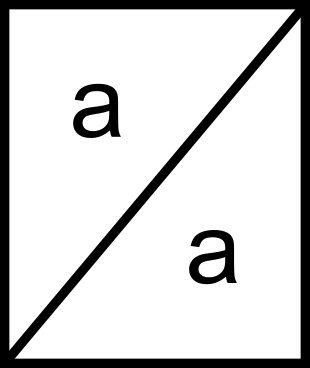 .
Can't you imagine that the question how big is the area
of the triangle 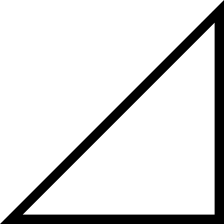 should make no sense to
you at all as you only talked of areas of
rectang[el|le]s. One might be inclined to say,
that the triangle had not really one particular area;
perhaps that there was a series of areas which could be said to
approach filling the triangle.
| | |
| | | | | | Privacy of
sensedata. I must
bore you by a repetition of what I said last time. We said
that peo one reason for introducing
the idea of the sense datum was that people, as we say,
somet⌊i⌋mes see different things, colours
e.g. when the looking at the same
object. Cases in which we say “he sees dark red
objects whereas I see light red”. This
We then are inclined to talk about an object other than
the physical object which the person sees who is said to see
the phys. obj.. It is further clear that we only gather from
the other persons behaviour
(e.g. what he tells us) what that
obj looks like & so it lies near to say
that he has this object before his mind's eye
& that we don't see it. Though we can
also say that we might have it before our mind
eye as well without however knowing that it is he has it
before his minds eye. The
‘sense datum’ ˇhere is the way
the physical object appears to him. In other cases no
phys object enters.
Now I
must draw your attention to one particular difficulty about the use of
the ‘sense datum’. We said that there
were cases in which we should say that the person sees green what I
see red. Now the question suggests itself: if this
can be so at all, why shouldnt it be al[l|w]ays the case?
It seems, if once we have admitted that it can happen under
peculiar circumstances that it may allways
happen. But then it is clear that the very idea of seeing
red loses its use if we can never know if the other
doesnt see something utterly different.
So what are we to do: Are we to say that this can only
happen in a limited number of cases? This is a very
serious situation. – We introduced the expression
that A sees something else than B & we
mustn't forget that this had only
under the circumstances under
which we introduced it. Concider the
prop: “Of course we
never know whether new circs
wouldn't show that after all he saw what we
see” Remember that this
hole notion need not have been introduced.
“But can't I imagine all blind men to
see as well as I do & only behaving differently; & on
the other hand imagine them really blind? For if I can
imagine these possibilities then the question even if never answerable
makes sense.” Imagine a man say W.
now blind, now seeing & observe what you
do? How do these im⌊a⌋ges give sense to the
question? They don't & you see that the
expression stands & falls with its
usefulness
“But I know The idea that the
other person sees something else than I is only introduced
certain expressions; whereas
it seems that this idea can exist without any reference to
expressions. “Surely what I have he too can
have.”
“And remember that we admit that the other
may have pain without showing it!”
So wh if this is conceivable, why not that he
never shows that he has pain;”
& why not that everybody has pain constantly without showing
it; or that even things have pain?!” What
strikes us is that there seem to be a few usefull
applications of the idea of the other persons
having pain without showing it & a vast number of useless
applications, applications which look as though they were no
applications at all. And these latter applications seem to
have their justification in this that we can imagine the other person
to have what we have & in this way the
prop that he has toothache seems to make
sense appart from any expression at all.
“Surely”, we say,
“[We| I] can imagine him to have pain or to
see, etc..” Or “As
I can see myself so I can imagine him to do the
same”. In other words I can imagine him to play the same role in the act
of seeing which I play. But does saying this determine what
I mean by “he sees”?
We arrive at
the conclusion that imagining him to have pain
(etc.) does not fix thes sense of the
sentence “he has pain”.
“He may all along mean something different by
‘green’ than I mean.” Evidence
(Verification). But there is this
consideration: “Surely I mean something
particular, a particular impression & therefore he may have
an other impression; surely I
know what that would be like!”
“Surely I know what it is like to have the impression I
call ‘green’!” But what is it
like? You are inclined to look at a green
object & to say “it's like
this!”. And these words though
they don't explain anything to anybody else seem to be at
any rate an explanation you give yourself. But are
they?! Will this explanation justify your future
use of the word ‘green’? In fact seeing
green doesnt allow you to make the
substitutions of someone else for you and of red for green.
“The sensedatum is
private” is a rule of grammar,
it forbids to use such expressions as “they saw the same
sensedatum” it may (or
may not) allow such sentences as “he guessed that the
other had a sensedatum of this
… kind”. It may only allow expressions of
the form: “The other looked round, had a
sensedatum and said
…”. You see that the use of this word
in such a case has no use at all.” But
if you like to use it, do! –
“But
surely I distinguish between having toothache & expressing it,
& merely expressing it”; & I
distinguish between these two in myself.”
“Surely this is not merely a matter of using different
expressions, but there are two distinct
experiences!” “You talk as though the
case of having pain & that of not having pain were only
distinguished by the way in which I expressed
myself!”
But do we always distinguish
between ‘mere behaviour’ &
‘experience & behaviour’? If we
see someone falling into flames & cr⌊y⌋ing out do we say
to ourselves: “there are of course two cases
…”? Or if I see you here before me do I
distingu⌊i⌋sh?? Do you? You
can't! That we do in
certain cases doesn't show that we do in all cases.
This to some of you must sound silly &
superficial; but it isn't. When you see me do you
see one thing & conjecture another?
(Don't talk of conjecturing
subconsciously!) But supposing you expressed yourself
in the form of such a supposition wouldn't this
come to adopting a ‘façon de
parler’?
Can we say that
‘saying that I lie is justified by a particular
experience of lying’. Shall we say
‘… by a particular priv.
experience’? or ‘… by a part.
priv. exp. of
lying’? or ‘by a part.
priv. exp.
characterized in such & such ways’?
“But what, in your opinion is the difference
between the mere expression & the expression & the
experience?”
| | |
| | | | | |
“Do you know what it means that W. behaves as
he does but sees nothing; & on the other hand that he
sees?”
If you ask yourself this &
answer ‘yes’ you conger up
some sort of image. This image is it seems derived
from the fact of your seeing or not seeing (if
you close your eyes) & by this derivation, it seems, it
must be the picture we interpret to correspond to our sentence
“he sees”, “he doesn't
see”. – As when I substitute my body for his
body & for holding a match holding a pen. –
But substituting his body for my body might mean that my body has
changed so as to be now like his, & perhaps vice
versa. It seems a direkt &
simple thing to understand
“ that he has
what I have” but it isn'tt at
all. The case is simple only if we speak
e.g. of physiological processes.
“I know only indirectly what he sees but
directely what I see.” embodies an
absolutely misleading picture. I
can't be said to know that I have toothache if I
can't be said not to know that I have toothache.
I can't be said to know indirectely
that the other has if I can't be said to know it
directely. The misleading picture is this
I see my own machbox but know only from hearsay what
his looks like. We can't say: “I
say he has t. because I
observe his behaviour but I say that I have because I
feel it”. (This might lead one
to say that ‘t.’ has
two meanings, one for me & one for the otherˇ
being)
“I say
‘I have t’ because I
feel it” contrasts this case with, say, the
case of acting on the stage but can't explain what
‘having t’ means because
having t = feeling
t & the explanation would come to
“I say I have it because I have it”. = I
say I have it because it is true. = I say I have it because I
don't ly. One wishes to
say: In order to be able to say that I have
t. I don't observe my
behaviour, say in the miror. And this is
correct, but it doesn't follow that you
d[i|e]scribe an observation of any other
kind. Moaning is not the description of an
observation. ˇThat is
You
can't be said to derive your expression from what
you observe. Just as you can't be said
to derive the word ‘green’ from your
visual impression but only from a sample. –
Now against this one is inclined to say:
“Surely if I call a colour green I don't just
say that word, but the word comes in a particular way”,
or “if I say I have
toothache’ I don't just use this phrase but it must
come in a particular way!” Now this means
nothing for, if you like, it always comes in a particular
way. “But surely seeing & saying
something can't be all!”
Here we make the confusion that there is still an object
we haven't mentioned. You imagine there is a
pure seeing & saying & one +
something else. Therefore you imagine all
distinctions to be made as between
a, a+b,
a+c, etc. The idea of this
addition is mostly derived from considerations of our
bodily organs. Wh
All that ought to interest you is whether I make all the
distinctions which you make: whether e.g.
I dont disting⌊u⌋ish between
[s|c]heating & telling the truth. –
“There is something else!” –
“There is nothing else!”.
– – – “But what else is there? –
“[B|W]ell
this→!”.
“But surely I know that I am not a mere
automaton!” – What would it be like if I
weren't? – “How is it that I can't imagine myself
not experiencing
seeing, hearing
etc. |
?”
– We constantly confuse & change about the
comon sense use & the metaphysical use.
“I know that I
see.” –
“I see.”
– you seem to read this off some fact; as though you said:
“There is a chair in this corner.”
“But if in an experiment, e.g.
I say ‘I see’ why do I say so? surely because
I see!”
It is as though our expressions of
personal experience needn't even spring from
[c|r]egularly recurrent inner experiences but
just from something.
Confusion of
description & sample.
| | |
| | | | | | The idea of the ‘realm of
consciousness’.
| | |
| | | | | |
Sir it is to see
all the
discussion going on about the harmfulness of
the gangster films to the young
while the minds of both
adults
& children [is|are] being systematically
poisoned by the
Vansitartt
newsreel comments in our
cinemas
propaganda made by
the ˇcinema newsreels |
, & by
the M.O.P. Can there be anything
more
than the gloating war news of the
British Movietone News unless it be
that of
Universal News? The gloating over
dead ‘Huns’ over the old German
citys razed to the ground
flattened |
over
German civilians who walking the ruins
of there
towns? Nobody
doubts
Everybody knows
about |
the unspeakable horrors of the Nazi Regime
which are perhaps comparable only to … When they
were in full swing long before the war had started
& even after it had started we heard very little about them
… Now that the enemy is completely
finished to use the words
Now |
all the well known tricks of the
camera & the by far nastier ones of the commentators are
set into action motion to make represent the
German people to the unthinking cinema goer look
appear like a as one pack of
woolves. The commentators are worthy pupils of
Dr Goebbels, of
worst kind of Germans. We are not writing
this letter in what would be a
crazy expectation to open the eyes of the blind, but to
direct the attention of the seeing to a horrid evil the lying
propaganda the germ of Nazism itself.
| | |
)
)
)
) .
Can't you imagine that the question how big is the area
of the triangle
) should make no sense to
you at all as you only talked of areas of
rectang[el|le]s. One might be inclined to say,
that the triangle had not really one particular area;
perhaps that there was a series of areas which could be said to
approach filling the triangle.